


Follow the latest changes in the corporate accounting regime under Circular 99 – these amendments have a direct impact on FDI enterprises in Vietnam.
This article will help clarify the matter comprehensively, while also providing an overview and detailed guidance on the official accounting regimes that FDI enterprises, particularly Japanese companies, are required to comply with.
Overview of Circular 99/2025/TT-BTC

Circular 99/2025/TT-BTC issued on October 27, 2025 takes effect from January 1, 2026, replacing Circular 200/2014/TT-BTC, and provides the latest guidance on the corporate accounting regime.
Key highlights of Circular 99/2025/TT-BTC:
- Scope of application: Applicable to enterprises in all sectors and all economic segments
- Increased autonomy: Enterprises are allowed to design their own templates for accounting vouchers and accounting books in accordance with their business characteristics, while ensuring compliance with the Accounting Law
- Modernization: The new accounting regime is oriented toward digital transformation, standardization of transparent financial reporting, and alignment with current accounting standards
- Effective date: Applicable from the fiscal year starting January 1, 2026, fully replacing Circular 200
Note:
Small and medium-sized enterprises may still choose to apply either Circular 99/2025 or Circular 133/2016.
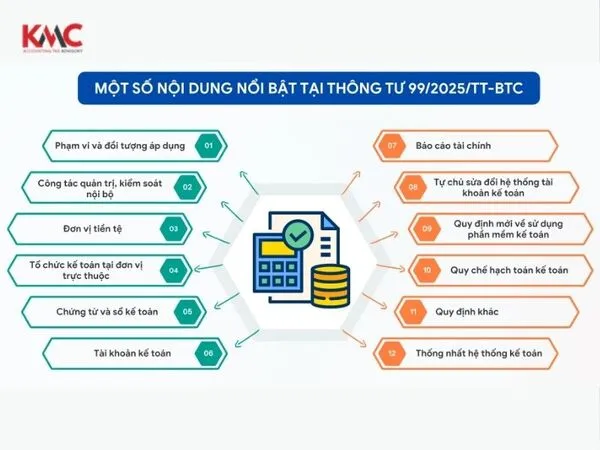
Main Contents of Circular 99/2025/TT-BTC
The main contents of the corporate accounting regime under Circular 99 include:
Chapter | Contents of Circular No. 99/2025/TT-BTC |
| Chapter I – General Provisions | Article 1. Scope of Regulation |
| Article 2. Applicable Entities | |
| Article 3. Corporate Governance and Internal Control | |
| Article 4. Accounting Currency | |
| Article 5. Change of Accounting Currency | |
| Article 6. Accounting Practices where Enterprises Select an Accounting Currency Other than Vietnam Dong | |
| Article 7. Organization of the Accounting Apparatus and Accounting Functions at Dependent Units of Enterprises | |
| Chapter II – Accounting Vouchers | Article 8. General Provisions on Accounting Vouchers |
| Article 9. Standard Forms of Accounting Vouchers | |
| Article 10. Preparation, Signing, and Control of Accounting Vouchers | |
| Chapter III – Chart of Accounts | Article 11. Accounting Chart of Accounts |
| Chapter IV – Accounting Books | Article 12. Accounting Books |
| Article 13. Opening, Recording, and Closing of Accounting Books | |
| Chapter V – Financial Statements | Article 14. Objectives of Financial Statements |
| Article 15. Financial Statement Reporting Periods | |
| Article 16. Entities Responsible for Preparation of Financial Statements | |
| Article 17. Corporate Financial Statement System | |
| Article 18. Amendments and Supplements to Financial Statements | |
| Article 19. Requirements for Information Presented in Financial Statements | |
| Article 20. Principles for Preparation and Presentation of Financial Statements under the Going Concern Assumption | |
| Article 21. Principles for Preparation and Presentation of Financial Statements upon Change in Accounting Period | |
| Article 22. Principles for Preparation and Presentation of Financial Statements upon Conversion of Enterprise Type | |
| Article 23. Principles for Preparation and Presentation of Financial Statements in Cases of Division, Separation, Consolidation, and Merger of Enterprises | |
| Article 24. Principles for Preparation and Presentation of Financial Statements where the Enterprise Does Not Meet the Going Concern Assumption | |
| Article 25. Deadline for Submission of Financial Statements | |
| Article 26. Recipients of Financial Statements | |
| Article 27. Disclosure of Financial Statements | |
| Chương VI – Tổ chức thực | Article 28. Regulations on the Use of Accounting Software |
| Article 29. Conversion of Balances in Accounting Books | |
| Article 30. Transitional Provisions | |
| Article 31. Implementation Provisions | |
| Appendices Issued Together with the Circular | |
| Appendix I | List of Standard Forms of Accounting Vouchers |
| Appendix II | Corporate Accounting Chart of Accounts |
| Appendix III | List of Standard Forms of Accounting Books |
| Appendix IV | List of Standard Forms of Financial Statements |
Corporate Accounting Regime under Circular 99 – Key Amendments and Supplements
Scope and Applicable Entities:
Applicable Entities | Circular 200/2014/TT-BTC | Circular 99/2025/TT-BTC |
| 1. Enterprises operating in all sectors and all economic segments | Yes | Yes |
| 2. Credit institutions and foreign bank branches applying accounting regimes or accounting legal regulations under the guidance of the State Bank of Vietnam | No | Yes |
The new Circular supplements credit institutions as applicable entities. For these entities, the Circular regulates non-specific operations such as inventories, fixed assets, and liabilities. Banking-specific operations will continue to comply with regulations issued by the State Bank of Vietnam.
In addition, other important amendments under the corporate accounting regime of Circular 99 include:
- Chart of accounts: Addition and amendment of certain Level 1 and Level 2 accounts to provide more detailed reflection of the nature of specific transactions. Enterprises are granted greater autonomy and flexibility in developing detailed account systems based on Appendix II of Circular 99.
- Financial Statements (FS): Amendments and supplements to items and indicators in the Financial Statements (Article 18) toward greater transparency and alignment with international standards.
- Accounting entries and bookkeeping: Updated detailed accounting guidance for new and complex transactions not fully covered under Circular 200, particularly those relating to financial instruments and digital assets.
- Corporate governance: Enhanced legal responsibility of enterprises when amending and supplementing internal accounting regulations.
- Accounting currency: Clearer regulations on the use of foreign currencies as accounting currencies.
Comparison between Circular 99/2025/TT-BTC and Circular 200/2014/TT-BTC
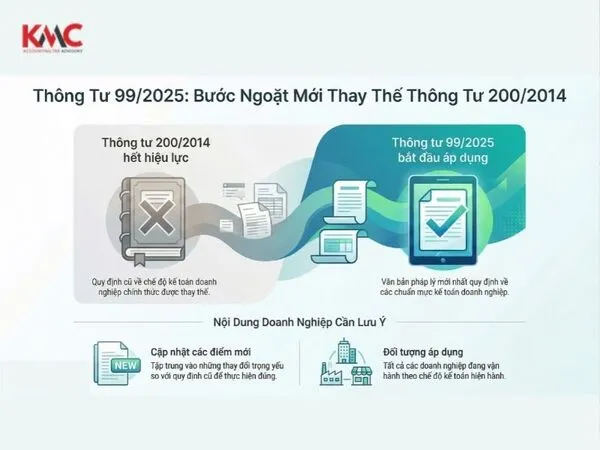
The amendments introduced under Circular 99 may cause concerns and difficulties for many enterprises and organizations. Below, KMC provides a quick comparison between Circular 200 and Circular 99 to help enterprises more easily understand the key points, amendments, and differences when applying the corporate accounting regime.
Criteria | Circular 200/2014/TT-BTC | Circular 99/2025/TT-BTC |
1. Scope and Applicable Entities | ||
| Applicable entities | Applicable to all types of enterprises, except micro-enterprises | Retains the same applicable entities while expanding application to foreign-invested enterprises, allowing optional partial or full IFRS adoption |
| Scope | Application of Vietnamese Accounting Standards (VAS) | Convergence with IFRS – moving toward harmonization between Vietnamese Accounting Standards (VAS 2025) and IFRS with a transition roadmap |
2. Chart of Accounts | ||
| Structure | 9 main account categories Level 1 accounts: 76 accounts | Retains 9 categories but restructures based on transaction substance Level 2 accounts: 71 accounts |
| New accounts | None | Level 1 accounts: Account 215, Account 332 Level 2 accounts: Account 2295, Account 1383, Account 1385, Account 6275, etc. Additional Level 3 accounts: Account 82111, Account 82112, etc. |
| Abolished accounts | x | Account 161, Account 611, Account 1562, Account 3385, Account 441, Account 461, Account 466, etc. |
| Revenue recognition | Based on transfer of risks and rewards | Convergence toward IFRS 15 five-step model, requiring identification of performance obligations, transaction price, and revenue allocation |
3. Financial Statements | ||
| Financial statement system | 4 reports (Balance Sheet, Income Statement, Cash Flow Statement, Notes to Financial Statements) | Retains 4 reports but renames the Balance Sheet to Statement of Financial Position |
| Supplementation/Amendment of financial statements | Any supplementation or amendment to templates, names, or contents of financial statement items requires written approval from the Ministry of Finance Existing items may be further detailed where appropriate | Enterprises may add additional items to financial statements (outside Appendix IV) if appropriate for management purposes Additional contents must be disclosed and supported by internal regulations Changes affecting the substance of prescribed items still require reporting to the Ministry of Finance for guidance |
| Financial statements of dependent units | Dependent units without legal entity status are still required to prepare separate financial statements according to the parent company’s reporting period for consolidation, inspection, and reconciliation purposes | Grants full discretion to the parent enterprise. Enterprises may choose whether or not to prepare separate financial statements for dependent units depending on organizational structure and management needs |
| Consolidated financial statements | When preparing consolidated financial statements between the enterprise and dependent units without legal entity status, internal balances, revenues, expenses, and unrealized gains/losses must be eliminated | Enterprises with dependent units must consolidate financial information of both headquarters and dependent units into enterprise financial statements |
| Accounting currency | VND, with permission to use foreign currency if conditions are met | Retains the same regulation but requires disclosure of the basis for selecting foreign currency |
| Treatment of items without balances | Items without balances are not required to be presented in financial statements Enterprises may renumber financial statement items based on continuity principles within each section | Items without balances are not required to be presented Enterprises are not permitted to renumber item codes (applicable to the Cash Flow Statement) |
Guidance on Applying the Accounting Regime for FDI Enterprises: From Regulations to Practice

To smoothly transition to or apply the corporate accounting regime under Circular 99, FDI enterprises should follow the steps below:
- Accurately determine the applicable entity: Based on the scale of the enterprise and actual reporting requirements to select the accounting regime in accordance with regulations.
- Update and train accounting personnel: Ensure the accounting department fully understands the new regulations, especially differences compared to the previous accounting regime (if any) or accounting practices applied in the parent company’s country.
- Adjust the chart of accounts and accounting software: Establish account lists, accounting books, and reporting templates in compliance with the selected Circular. This is a critical step for process automation and standardization.
- Develop internal procedures: Prepare or update internal accounting regulations and document circulation procedures in accordance with Vietnamese regulations.
Above, KMC has shared the basic information regarding Circular 99/2025/TT-BTC – the corporate accounting regime under Circular 99.
For FDI enterprises, complying with Vietnamese accounting standards is already challenging, while keeping up with new accounting, auditing, and regulatory policies is even more difficult and complex. Therefore, if you are managing an FDI enterprise in Vietnam and are seeking a professional service provider to support comprehensive accounting operations to ensure accuracy and legal compliance from the outset, contact KMC – a specialized consulting firm providing guidance and comprehensive accounting and tax solutions for FDI enterprises, especially Japanese-invested enterprises.
With a team of experienced professionals possessing in-depth knowledge of both Vietnamese and international accounting systems, along with a proactive approach to continuously updating the latest tax, accounting, and corporate legal regulations, KMC helps enterprises shorten the path toward accurate and efficient compliance, transforming legal challenges into a solid foundation for sustainable development.
For consultation from KMC experts, please contact hotline: 081 489 4789.
