



Late payment of taxes can lead to an increase in tax liabilities, and enterprises may also incur late payment penalties. Alongside this, the accounting treatment of tax late payment interest is also an issue of concern for many accountants. In the following section, experts from KMC will clarify where tax late payment interest should be recorded and provide detailed guidance on how to calculate and account for tax late payment penalties in accordance with regulations, with particular attention to provisions applicable to FDI enterprises.
Tax payment deadlines in accordance with legal regulations
According to Clause 1, Article 55 of Law on Tax Administration No. 38/2019/QH14:
In cases where the taxpayer self-calculates tax, the tax payment deadline is no later than the last day of the tax return filing deadline. In cases of amended tax declarations, the tax payment deadline is the filing deadline of the tax period containing the errors. If these deadlines are exceeded, the enterprise is considered to have made late tax payment and is required to calculate and account for corporate income tax (CIT) late payment interest.
Cases considered as late tax payment
Cases subject to accounting for tax late payment interest in accordance with Article 59 of the Law on Tax Administration 2019 include:
- Taxpayers who fail to pay tax on time compared to the statutory deadline, extended payment deadline, deadline stated in the tax authority’s notice, the deadline specified in a tax assessment decision, or a tax handling decision issued by the tax authority;
- Taxpayers who submit amended tax declarations that increase the payable tax amount, or where the tax authority or competent state authority, during inspection or audit, determines that the declared tax amount is insufficient, must pay late payment interest on the additional tax payable starting from the day following the original tax payment deadline of the tax period containing the errors, or from the customs declaration due date in case of import/export tax declarations;
- Taxpayers who submit amended tax declarations that reduce the refunded tax amount, or where the tax authority or competent authority determines that the refunded tax amount is lower than the amount already refunded, must pay late payment interest on the recoverable refunded amount starting from the date the refund was received from the state budget.
In addition to the three common cases above, there are other situations that may also result in the obligation to account for tax late payment interest. Refer to Article 59 of the Law on Tax Administration 2019 for further details.
Tax late payment interest calculation method
According to Article 59 of the Law on Tax Administration 2019 and its guiding regulations, the late payment interest rate is determined at 0.03% per day, calculated on the overdue tax amount. The formula is as follows:
Late payment interest = Overdue tax amount × 0.03% × Number of late payment days
The number of late payment days is calculated from the day following the tax payment deadline to the actual date the taxpayer fully pays the outstanding tax amount to the State budget.
Where is tax late payment interest recorded? Detailed accounting entries guidance

The accounting treatment depends on the accounting regime applied by the enterprise (Circular 200/2014/TT-BTC or Circular 133/2016/TT-BTC). However, the general principle is that it is not deductible as an expense when calculating corporate income tax (CIT).
For enterprises applying Circular 200/2014/TT-BTC (large enterprises, FDI)
Under Circular 200/2014/TT-BTC, tax late payment interest is recorded under Account 811 – Other expenses. When payment is made, cash or bank deposits are reduced accordingly.
Detailed accounting entries:
- Upon receipt of the tax authority’s notice of late payment interest:
Debit Account 811 – Other expenses
Credit Account 3339 – Taxes, fees and other payables (or Account 3338 – Other taxes depending on the detailed account setup)
- When actually paying the late payment interest to the State budget:
Debit Account 3339 (or 3338)
Credit Account 111, 112
- At period-end, when closing accounts and transferring late payment interest expense:
Debit Account 911 – Determination of business results
Credit Account 811 – Other expenses
2.For enterprises applying Circular 133 (small and medium-sized enterprises)
Under Circular 133, this amount is recorded in Account 642 – Administrative expenses (Account 6428 – Other cash expenses).
Detailed accounting entries:
- Upon receipt of the notice:
Debit Account 6428 – Other cash expenses
Credit Account 3339
- When making the payment:
Debit Account 3339
Credit Account 111, 112
Accounting for adjustment of additional assessed tax (tax reassessment)
After understanding where tax late payment interest is recorded and completing the accounting for late payment amounts, accountants must continue to record adjustments for additional assessed tax as follows:
Accounting for adjustment of additional assessed tax on accounting records:
- Additional assessed VAT:
Debit Account 4211 – Undistributed profit of previous years
Credit Account 3331 – Value Added Tax payable
- Additional assessed Corporate Income Tax (CIT):
Debit Account 4211 – Undistributed profit of previous years
Credit Account 3334 – Corporate Income Tax payable
- Additional assessed Personal Income Tax (PIT):
If deducted from employees’ salaries in the current period:
Debit Account 334 – Payables to employees
Credit Account 3335 – Personal Income Tax payable
If borne by the company:
Debit Account 4211 – Undistributed profit of previous years
Credit Account 3335 – Personal Income Tax payable
Accounting for additional assessed tax payable (underpaid tax) paid to the State budget
- Recording additional Corporate Income Tax (CIT) payable:
Debit Account 8211 – Current corporate income tax expense
Credit Account 3334 – Corporate Income Tax payable
- When paying the tax to the State budget:
Debit Account 3334 – Corporate Income Tax payable
Credit Account 111, 112
- Recording additional Value Added Tax (VAT) payable:
Debit Account 811 – Other expenses
Credit Account 3331 – Value Added Tax payable
- When paying the tax to the State budget:
Debit Account 3331 – Value Added Tax payable
Credit Account 111, 112
Practical guidance on implementation in common accounting software
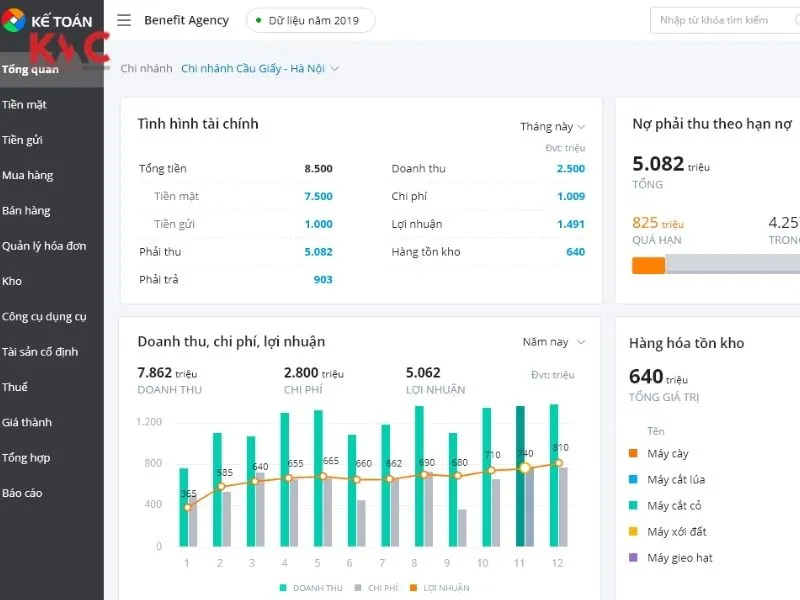
Although the theory is not too complex, in practice, accounting for tax late payment interest—especially on accounting software—can still cause difficulties for many accountants. Below is a basic step-by-step guide on several common systems:
On MISA SME.NET software
- Step 1: Go to General Accounting module > Select General Journal Voucher (or Closing Entries).
- Step 2: Create a new entry. The posting date is the date of receiving the tax penalty notice/decision.
Debit: Account 811 (or 6428)
Credit: Account 3339
Note: Enter the amount and clear description (e.g., “VAT late payment interest for March 2026 per Notice No…”).
- Step 3: Save and post the entry.
- Step 4: When making payment, go to Cash/Bank module > Create payment voucher. In the offset account section, select Account 3339 and enter the corresponding amount.
On FAST Accounting software
- Step 1: Go to Data Setup > Vouchers > Create a new voucher under General Journal type.
- Step 2: Enter details:
Debit account: 811 (or 642)
Credit account: 3339
Amount and description
Select tax type (if detailed setup is available).
Step 3: Post the voucher. When making payment, create a Cash Payment voucher, with Credit account as 111/112 and corresponding debit account as 3339.
Frequently Asked Questions (FAQ) about tax late payment interest

In addition to the question of where late payment interest on taxes should be recognized in the accounts, there are many other issues related to late payment interest on taxes that need to be clarified. Below, KMC provides concise answers to the most frequently asked questions!
Do FDI enterprises apply a different accounting treatment?
No. The principles for accounting recognition and tax treatment of late payment interest are applied uniformly to all types of enterprises, including FDI enterprises.
Is the accounting treatment for late payment interest on VAT, CIT, and PIT different?
No. Regardless of the type of tax, the nature of late payment interest remains the same. Therefore, the accounting treatment—recognition in expense accounts (811/642) and tax payable accounts (3339)—is consistent. The only difference lies in the notes or descriptions for internal tracking purposes.
When should late payment interest be calculated and recognized, and is the enterprise required to self-assess it?
Typically, the tax authority will issue a notice for late payment interest after the enterprise has underpaid or paid taxes late. However, to proactively manage cash flow and financial planning, the enterprise’s accounting function should estimate and accrue this amount as soon as it becomes aware of a potential late payment.
Recognition in the accounting records is performed only when there is a reliable basis for determination (such as an official notice) or when the enterprise can make a reasonable estimate for financial reporting purposes.
If the enterprise does not agree with the late payment interest amount, what should it do?
The enterprise has the right to lodge a complaint in accordance with the Law on Tax Administration. During the complaint process, it should still recognize the amount as notified. If a subsequent decision reduces or cancels the amount, the enterprise will record an adjustment to reduce the expense accordingly.
