



For an FDI enterprise expanding into a new market, establishing a subsidiary company remains the most commonly adopted solution. So what exactly is a subsidiary company? What roles and functions does a subsidiary perform? What conditions are required to establish a subsidiary?
In the following article, KMC will provide a detailed explanation of subsidiary companies and, in particular, a step-by-step guide for foreign investors on the procedures for establishing a subsidiary in Vietnam.
What is a parent company?
To understand what a subsidiary is, you must first understand the concept of a parent company and the relationship between these two types of entities.
According to Clause 1, Article 195 of the Law on Enterprises 2020, a company is considered a parent company of another company if it falls into one of the following cases:
- Holds more than 50% of the charter capital (for a limited liability company) or more than 50% of the total voting shares (for a joint-stock company);
- Has the authority to appoint key management positions such as the Chairman of the Members’ Council, Chairman of the Board of Directors, Director or General Director;
- Has the authority to decide on amendments and supplements to the company charter.
What is a subsidiary?
According to Clause 2 and Clause 3, Article 195 of the Law on Enterprises 2020:
- A subsidiary is not permitted to invest in or purchase shares of its parent company;
- Subsidiaries of the same parent company are not permitted to simultaneously contribute capital or purchase shares to create cross-ownership among themselves;
- Subsidiaries having the same parent company (where the parent company holds at least 65% state capital) are not permitted to jointly contribute capital, purchase shares in another enterprise, or establish a new company.
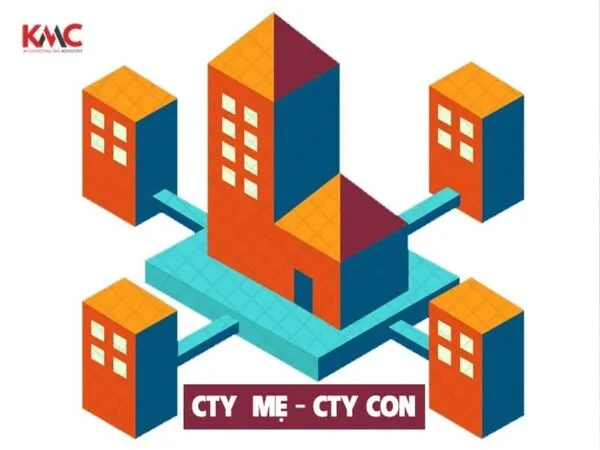
Accordingly, it can be simply understood that a subsidiary is a company in which another company holds more than 50% of its charter capital. Therefore, a parent company may have multiple subsidiaries, but a subsidiary has only one parent company.
Advantages and disadvantages of the subsidiary model
Before deciding to establish a subsidiary, enterprises need to clearly understand the advantages and disadvantages of this model.
Advantages
- Limitation of legal and financial risks: A subsidiary has independent legal entity status; therefore, if the subsidiary incurs losses or liabilities, the risk is limited to the contributed capital and does not directly affect the parent company’s assets.
- Business flexibility: The subsidiary model can operate independently and may differ in products and business lines from the parent company.
- Independent brand building: A subsidiary may have its own management structure, corporate culture, and branding strategy suitable for the Vietnamese market, allowing it to independently develop its brand and reputation.
- Tax structure optimization: Ability to leverage tax incentives applicable to specific locations or industries. The parent company and subsidiary are separate tax entities.
- Easier local capital mobilization: With independent legal entity status, a subsidiary can obtain loans from domestic banks based on its own financial capacity.
Disadvantages
- More complex establishment procedures: Requires enterprise registration as a new legal entity, including full documentation for foreign investors.
- Higher operating costs: Requires establishment of separate management, accounting, and HR systems.
- Financial and reporting burden: Must maintain separate accounting records, prepare standalone financial statements, and subsequently consolidate financial statements with the parent company.
- Challenges in overall control: Legal independence may lead to conflicts of interest or difficulties in fully implementing parent company policies, although the subsidiary remains controlled by the parent company (holding >50% ownership).
- Risks from other shareholders/members: If the subsidiary is not wholly owned, decisions may be influenced by other shareholders or members.
Rights, obligations and liabilities of the parent company
The relationship between a parent company and its subsidiary is not only based on capital investment but also encompasses legally binding rights and obligations:
- Rights of the parent company: Entitled to receive profit distributions from the subsidiary; exercise management and supervision rights in accordance with its ownership interest and the company charter; and transfer its equity interest.
- Obligations of the parent company: Comply with provisions set out in the company charter; fully and timely contribute the committed capital; and not unlawfully interfere in the business operations of the subsidiary.
- Joint liability: Under the Law on Enterprises, the parent company bears joint liability for financial obligations arising from the subsidiary if it unlawfully interferes and causes damage to the subsidiary or its creditors. In cases of abuse leading to the subsidiary’s bankruptcy, the parent company may be liable for settling outstanding debts.
Distinguishing a subsidiary from other business models

Having understood what a subsidiary is, you may still be wondering about the differences between a subsidiary, a branch, and a representative office. To help you distinguish these three distinct organizational models, KMC provides a quick and detailed comparison table below.
Criteria | Subsidiary | Branch | Representative Office |
| Legal status | Has legal entity status (fully independent) | No (dependent unit of the foreign company) | No (dependent unit of the foreign company) |
| Function | Independent Business operations, may operate in different industries from the parent company | Conducts all or part of the parent company’s business activities | Trade promotion, marketing, liaison activities (not permitted to conduct business operations or sign commercial contracts) |
| Financial autonomy | Yes (separate financial statements) | No (dependent on parent company) | No (dependent on parent company) |
Seal & invoices | Has its own seal and invoices | Has seal and may issue invoices | Has its own seal, no invoices |
| Liability | Independently liable within contributed capital | Parent company bears joint liability | Parent company bears joint liability |
| Purpose | Business expansion with controlled risk | Business scale expansion, sales operations | Market promotion and market research |
The choice of model depends on the strategy of each organization or enterprise:
- Establish a Subsidiary when the enterprise wants to completely separate legal and financial risks.
- Establish a Branch when the enterprise wants to open a business location, sign contracts, and issue invoices in another locality while still remaining under the parent company’s control.
- Establish a Representative Office when only an office presence is needed for product introduction and promotion, without generating revenue.
Procedures and process for establishing a subsidiary in Vietnam for FDI enterprises
Comprehensive explanation of what a subsidiary is, and detailed procedures for establishing a subsidiary for FDI enterprises. In practice, the documentation and procedures for establishing a subsidiary of an FDI enterprise are similar to the process of establishing an FDI enterprise in Vietnam. The key difference is that a subsidiary will have a shareholder holding more than 50% of its charter capital.

The basic process includes 4 steps as follows:
Step 1: Preparation of investment project dossier
The investor must prepare an investment project proposal, including: objectives, scale, location, technology, environmental protection solutions, and assessment of socio-economic impacts.
Note: For certain conditional business lines, sub-licenses (such as insurance business license, banking license, etc.) may be applied for in parallel or after the Investment Registration Certificate is issued.
Step 2: Application for Investment Registration Certificate (IRC)
The dossier is submitted to the investment registration authority (usually the Department of Planning and Investment of the province/city where the project is located).
The dossier includes: application form for project implementation, legal documents of the investor (foreign business registration certificate legalized by consular authentication), investment project proposal, and financial capacity proof documents. The appraisal period is up to 15 working days (for projects not subject to appraisal procedures).
Step 3: Application for Enterprise Registration Certificate (ERC)
After obtaining the IRC, the investor proceeds with establishing the legal entity (subsidiary). The dossier includes:
- Application for enterprise registration
- Company charter
- List of shareholders (for joint-stock subsidiary companies)
- List of members (for limited liability companies with 2 or more members)
- Depending on the parent company type, additional documents on appointment of capital contribution representatives and management decisions must be included:
- Owner decision (for single-member LLC subsidiary)
- Members’ Council Chairman decision (for multi-member LLC subsidiary)
- Board of Directors resolution (for joint-stock company subsidiary)
- Certified copy of the IRC and other related documents
Step 4: Post-establishment procedures
After receiving the Enterprise Registration Certificate, the subsidiary must complete the following procedures:
- Engrave company seal and publish seal specimen
- Open bank account and notify account information
- Register tax calculation method and initial tax declaration
- Purchase, print, and issue electronic invoices
- Register social insurance for employees
- Display company signboard at the head office
Reliable end-to-end subsidiary establishment services for FDI enterprises
The above, KMC has provided a comprehensive explanation of what a subsidiary is, as well as a detailed guide to the procedures for establishing a subsidiary for FDI enterprises with foreign capital investment.

It can be seen that establishing a subsidiary is a process that requires careful preparation and investment, especially when the parent company is a foreign-invested enterprise operating outside Vietnam. If you are a foreign investor looking to expand into the Vietnamese market through a subsidiary model, and you need a professional partner to support you from subsidiary establishment procedures to other necessary legal requirements, please contact KMC.
KMC is a professional consulting firm specializing in providing tax, accounting, legal, and HR solutions for FDI enterprises, particularly Japanese-invested companies. We support all types of business structures, including companies, branches, representative offices, and subsidiaries.
We provide comprehensive and in-depth support, including:
- Consulting on necessary legal procedures
- Assisting in preparing a complete dossier for subsidiary establishment
- Representing enterprises in performing business registration procedures for subsidiary incorporation
- Completing post-licensing legal procedures after obtaining the Enterprise Registration Certificate
With strong credibility, extensive experience, and a team of lawyers and experts with in-depth knowledge of Vietnamese regulations, we are committed to providing a standard process that ensures full legal compliance from the outset. We support fast, professional, and cost-optimized subsidiary establishment for all clients and investors.
For in-depth consultation from experts, please contact our hotline: 081 489 4789.
