



As a foreign-invested enterprise (FDI), are you looking for an accurate capital contribution transfer agreement template, along with detailed guidance to confidently complete the transaction? Are you concerned about complex legal procedures, potential tax liabilities, or hidden risks that may affect your rights and interests? This article is specifically designed for you—managers and investors in FDI enterprises, especially Japanese companies—with the aim of providing a comprehensive end-to-end solution.
We understand that for an important transaction such as capital contribution transfer, having a standard capital contribution transfer agreement is only the starting point. You need to clearly understand each clause, master the legal procedures specific to FDI enterprises, and accurately estimate all related costs. Below is everything you need to know.
1.Download the Standard Capital Contribution Transfer Agreement Template for Enterprises
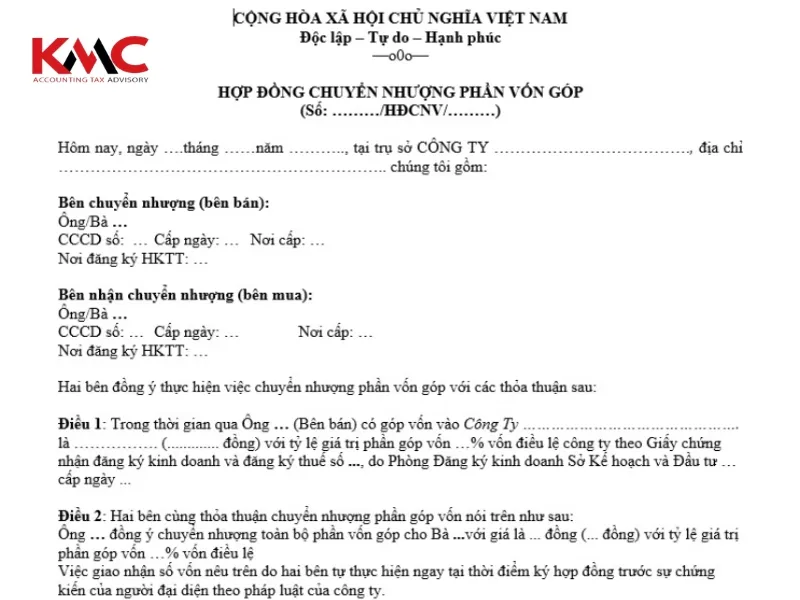
Time is money, especially in an international business environment. Instead of spending hours drafting from scratch, you can immediately use a template prepared based on the provisions of the 2020 Law on Enterprises and practical application in FDI transactions. This capital contribution transfer agreement template includes all essential and fundamental clauses, suitable for most standard transfer cases.
DOWNLOAD THE CAPITAL CONTRIBUTION TRANSFER AGREEMENT TEMPLATE: HERE !
Accompanying the document template, we provide a detailed explanation of key clauses:
- Transfer subject matter clause: Clearly describes the exact percentage, capital amount, and type of contributed assets.
- Price and payment method clause: Notes on valuation, cross-border payment currency, and payment schedule.
- Representations and warranties clause: Important legal commitments to protect the buyer from hidden liabilities.
- Conditions precedent clause: Defines the effective date of the transaction, typically linked to approval from the investment licensing authority.
2.6-Step Legal Procedure for FDI Enterprises
Signing a capital contribution transfer agreement is only the first step. In order for the transaction to be fully legally effective and recognized by the State, FDI enterprises must comply with a strict procedure:
- Review the company charter and approval resolution: All transactions must comply with the pre-emptive rights stipulated in the Charter. A Resolution of the Members’ Council or General Meeting of Shareholders is mandatory.
- Due diligence and valuation: If the capital contribution is made in non-cash assets, valuation must be conducted by an independent valuation organization.
- Signing the capital contribution transfer agreement: Use a template adjusted in accordance with the specific agreement between the parties.
- Fulfillment of tax obligations: The transferor must pay tax on the capital gain. This is the most important financial step before proceeding with subsequent procedures.
- Submission to the investment authority: FDI enterprises must carry out procedures to amend the Investment Registration Certificate (IRC) upon changes in foreign investors, in accordance with the Law on Investment 2020.
- Update information with the Department of Planning and Investment: Finally, the enterprise submits the dossier for changes in capital contributors to update the National Business Registration Information System.

3.Checklist of Required Documents
To avoid unnecessary omissions and delays, please use the following checklist:
- Signed and duly stamped Capital Contribution Transfer Agreement
- Resolution and Minutes of Meeting of the Members’ Council/Shareholders approving the transfer
- Tax clearance confirmation from the direct tax authority confirming completion of tax obligations
- Copies of the current Investment Registration Certificate (IRC) and Enterprise Registration Certificate (ERC)
- Legal documents of the parties (Passport or Business License with consular legalization)
- Application for amendment of the Investment Registration Certificate (IRC)
4.Estimated Taxes and Related Costs for Capital Contribution Transfers
Costs are a key concern for investors. When executing a capital contribution transfer agreement, you should note:
- Personal Income Tax (PIT): A tax rate of 20% is applied to the capital gain for individuals.
- Corporate Income Tax (CIT): A standard tax rate of 20% is applied to the profit from capital transfer for organizations.
- Enterprise registration fee: Fee for submitting changes to business registration contents.
- Professional service fees: Costs of engaging consultants to ensure the legal safety of the capital contribution transfer agreement.

5. Legal Risks and Preventive Measures for FDI Enterprises
Understanding risks is the best way to prevent them. Common real-life situations include:
- Invalid contract: Due to violation of the pre-emptive purchase rights of existing members as stipulated in the Charter.
- Delayed investment reporting: Failure to update the IRC on time may result in significant administrative penalties, which Japanese enterprises are particularly cautious about.
- Payment disputes: Lack of clarity regarding applicable exchange rates or payment schedule in the capital contribution transfer agreement.
6.Frequently Asked Questions on Capital Contribution Transfer Agreement
- Is notarization of the capital contribution transfer agreement mandatory?
According to the 2020 Law on Enterprises, this document must be notarized or certified if required by the company’s Charter or for the purpose of registering changes of members with the competent authority. - Do FDI enterprises need to re-apply for approval when changing foreign investors?
It is not necessary to obtain new approval from the beginning; instead, an amendment to the Investment Registration Certificate (IRC) must be carried out. This is a mandatory requirement to record the new investor’s status. - How long does the entire procedure take?
It typically takes 15 to 30 working days from the signing of the capital contribution transfer agreement, depending on the completion of tax obligations and the processing time of the investment authority.

7. Why Is Support from FDI Legal Experts Necessary?
A capital contribution transfer agreement may seem simple, but it contains many complex issues, especially as Vietnam’s investment laws are continuously updated. A small drafting error may lead to significant financial consequences.
KMC’s legal expert team, with extensive experience advising Japanese corporations, will accompany you to:
- Provide in-depth consultation, drafting, and review of the capital contribution transfer agreement to maximize investor protection.
- Provide end-to-end support: from tax documentation preparation to working with investment licensing authorities.
- Optimize tax obligations in a legally compliant manner through specialized tax and accounting solutions.
Do not let legal risks slow down your business growth. Contact KMC immediately at 081 489 4789 to receive a complete capital contribution transfer agreement template and dedicated professional consultation for your case.
